- Analytics
- News and Tools
- Market News
- Gold edges higher as tariff hints further develop
Gold edges higher as tariff hints further develop
- Gold extends bullish momentum after fresh comments from President Trump on incoming tariffs.
- Nobody seems safe, with the focus on China and Europe.
- Gold prints a fresh over two-month high and sets sail to the all-time high of $2,790.
Gold’s price (XAU/USD) extends its upside move and trades above $2,760 at the time of writing on Wednesday after booking over 1.20% gains the previous day. The bullish momentum is fueled by new US President Donald Trump’s comments on tariffs. This time, a 10% levy on Chinese goods triggered the leg higher in Bullion.
Meanwhile, investors remain focused on the implications of the Trump administration’s tariff and tax cut policies, which would likely erode the nation’s finances and lead to an inflation boom. That may limit the Federal Reserve’s (Fed) ability to keep easing monetary policy. Higher borrowing costs typically pose a headwind for Bullion regarding the correlation between the two assets.
Daily digest market movers: Tariff news keeps hitting
- Zimbabwe Gold exports rose to $1.44 billion last year from $1.22 billion in 2023, according to data from the Reserve Bank of Zimbabwe, Bloomberg reports.
- Silver futures briefly spiked after Trump’s comments on tariffs for China, Mexico and Canada. Mexico is the top miner of Silver, and it is unclear whether the tariffs would apply to imports of the metal, Reuters reports.
- US Treasuries cannot catch a breath and are on the backfoot again, with the US 10-year benchmark trading at 4.56%, not far from its yearly low near 4.528% seen on Tuesday.
Technical Analysis: Keep an eye on any inflation measure
All is well for Gold now, with the precious metal on a tear. However, that might quickly change once US inflation data comes in. Moreover, should inflation point to a resurgence in price pressures, expect to see Gold traders take their profit and run. So enjoy the rally, for now, as it could start to turn once inflation surges again.
Profit-taking could emerge and push Gold’s price back to $2,700, with the downward-slopping trendline of the broken pennant chart pattern last week at $2,668 as the next support. In case more downside occurs, the 55-day Simple Moving Average (SMA) and the 100-day SMA converging at around $2,649 is the next level to watch.
Gold is now on its way to $2,790, which is still over 1% away from current levels. Once above that, a fresh all-time high will present itself. Meanwhile, some analysts and strategists have penciled in calls for $3,000, but $2,800 looks to be a good starting point as the next resistance on the upside.
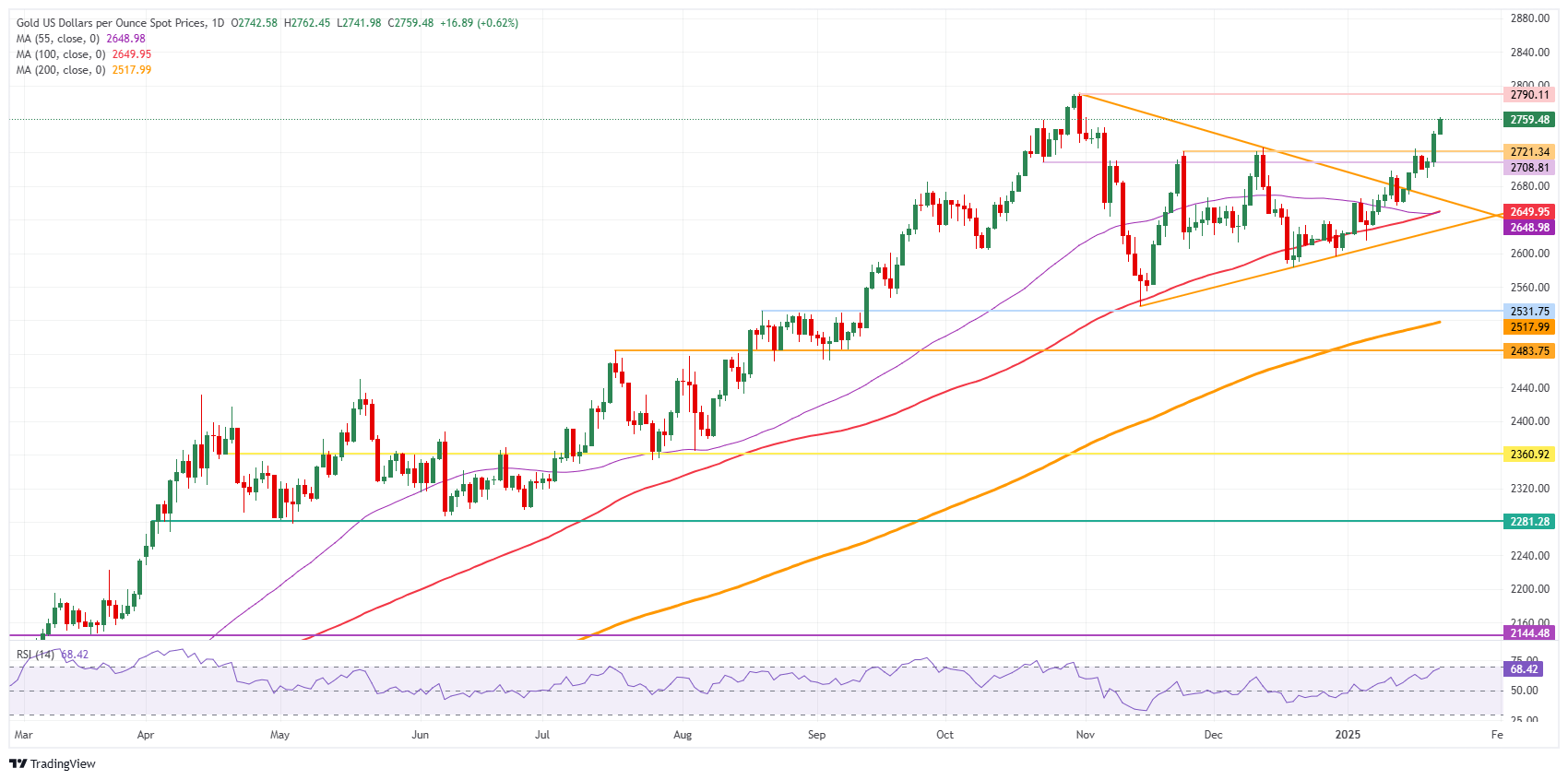
XAU/USD: Daily Chart
Gold FAQs
Gold has played a key role in human’s history as it has been widely used as a store of value and medium of exchange. Currently, apart from its shine and usage for jewelry, the precious metal is widely seen as a safe-haven asset, meaning that it is considered a good investment during turbulent times. Gold is also widely seen as a hedge against inflation and against depreciating currencies as it doesn’t rely on any specific issuer or government.
Central banks are the biggest Gold holders. In their aim to support their currencies in turbulent times, central banks tend to diversify their reserves and buy Gold to improve the perceived strength of the economy and the currency. High Gold reserves can be a source of trust for a country’s solvency. Central banks added 1,136 tonnes of Gold worth around $70 billion to their reserves in 2022, according to data from the World Gold Council. This is the highest yearly purchase since records began. Central banks from emerging economies such as China, India and Turkey are quickly increasing their Gold reserves.
Gold has an inverse correlation with the US Dollar and US Treasuries, which are both major reserve and safe-haven assets. When the Dollar depreciates, Gold tends to rise, enabling investors and central banks to diversify their assets in turbulent times. Gold is also inversely correlated with risk assets. A rally in the stock market tends to weaken Gold price, while sell-offs in riskier markets tend to favor the precious metal.
The price can move due to a wide range of factors. Geopolitical instability or fears of a deep recession can quickly make Gold price escalate due to its safe-haven status. As a yield-less asset, Gold tends to rise with lower interest rates, while higher cost of money usually weighs down on the yellow metal. Still, most moves depend on how the US Dollar (USD) behaves as the asset is priced in dollars (XAU/USD). A strong Dollar tends to keep the price of Gold controlled, whereas a weaker Dollar is likely to push Gold prices up.







© 2000-2026. All rights reserved.
This site is managed by Teletrade D.J. LLC 2351 LLC 2022 (Euro House, Richmond Hill Road, Kingstown, VC0100, St. Vincent and the Grenadines).
The information on this website is for informational purposes only and does not constitute any investment advice.
The company does not serve or provide services to customers who are residents of the US, Canada, Iran, The Democratic People's Republic of Korea, Yemen and FATF blacklisted countries.
Making transactions on financial markets with marginal financial instruments opens up wide possibilities and allows investors who are willing to take risks to earn high profits, carrying a potentially high risk of losses at the same time. Therefore you should responsibly approach the issue of choosing the appropriate investment strategy, taking the available resources into account, before starting trading.
Use of the information: full or partial use of materials from this website must always be referenced to TeleTrade as the source of information. Use of the materials on the Internet must be accompanied by a hyperlink to teletrade.org. Automatic import of materials and information from this website is prohibited.
Please contact our PR department if you have any questions or need assistance at pr@teletrade.global.


 Bank
Bank transfers


