- Analytics
- News and Tools
- Market News
- USD/CAD Price Forecast: Refreshes multi-year high above 1.4300
USD/CAD Price Forecast: Refreshes multi-year high above 1.4300
- USD/CAD rises further to near 1.4330 as the Canadian Dollar weakens amid growing risks of inflation undershooting BoC’s target of 2%.
- The US Dollar consolidates ahead of the Fed’s policy meeting outcome.
- Investors expect the Fed to deliver slightly hawkish remarks on the policy outlook.
The USD/CAD pair posts a fresh more than four-year high around 1.4330 on Wednesday. The Loonie pair extends Tuesday’s rally on Wednesday, which was prompted by softer-than-expected Canadian Consumer Price Index (CPI) data for November.
The inflation report showed that the headline Consumer Price Index (CPI) rose by 1.9%, slower than estimates and the prior release of 2%. Month-on-month headline inflation remained flat, as expected. In October, the monthly headline CPI rose by 0.4%. Soft inflation data boosted expectations of more outsize interest rate cuts by the Bank of Canada (BoC). However, BoC Governor Tiff Macklem said last week that the central bank will shift to a more gradual policy-easing stance.
Additionally, political uncertainty in Canada has weighed on the Canadian Dollar (CAD). At the beginning of the week, Canadian Finance Minister Chrystia Freeland resigned after a policy clash with Prime Minister Justin Trudeau.
Meanwhile, the US Dollar (USD) stays in a tight range, with investors awaiting the Federal Reserve’s (Fed) policy outcome at 20:00 GMT. The Fed is widely expected to cut interest rates by 25 basis points (bps) to 4.25%- 4.50%, with slightly hawkish guidance.
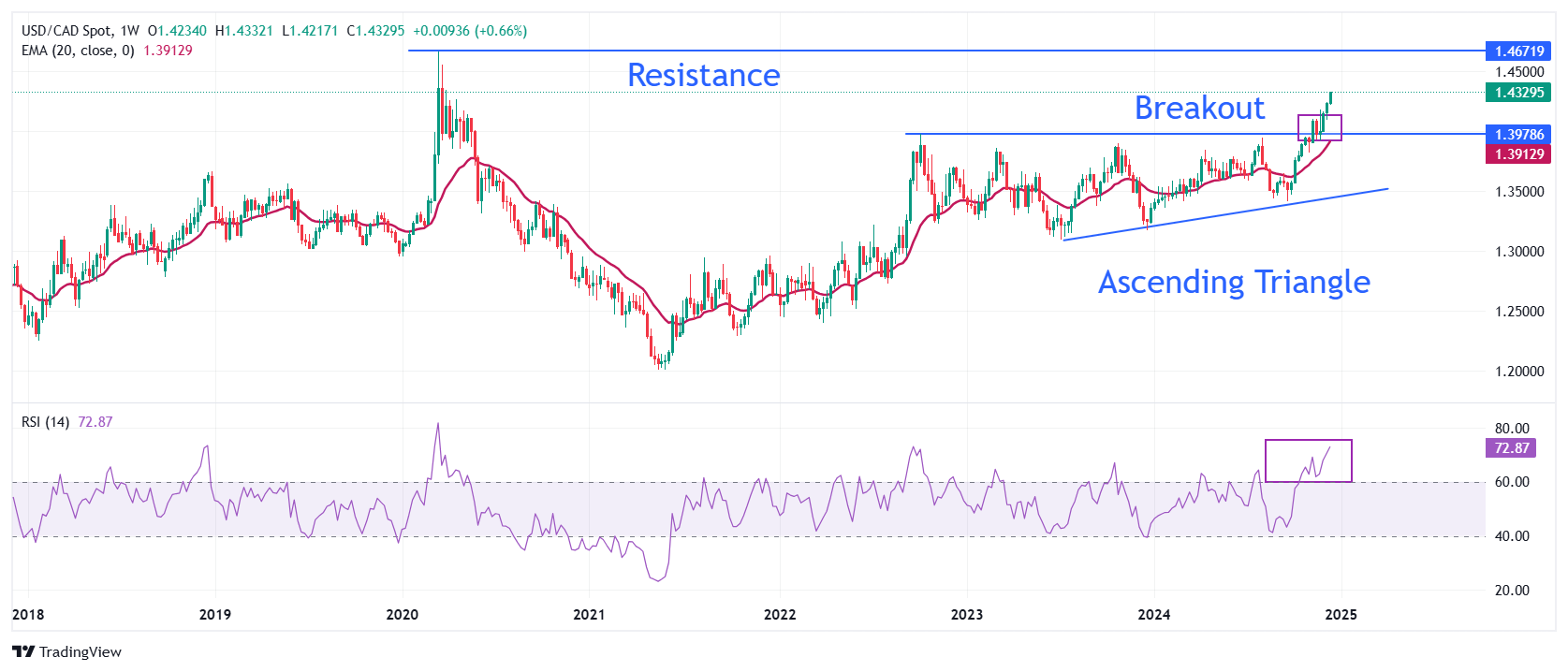
USD/CAD has shown a stalwart rally after a breakout of the Ascending Triangle chart pattern on a weekly timeframe. The upward-sloping 20-day Exponential Moving Average (EMA) near 1.3900 suggests that the overall trend is bullish.
The 14-day Relative Strength Index (RSI) oscillates in the bullish range of 60.00-80.00, suggesting that a strong upside momentum is intact.
The rally in the Loonie pair could advance to the round-level figure of 1.4400 and the psychological resistance of 1.4500 if the asset breaks above 1.4350.
On the contrary, a downside move below the December 11 low of 1.4120 could drag the asset towards the December 4 high of around 1.4080, followed by the psychological support of 1.4000.
USD/CAD weekly chart
Canadian Dollar FAQs
The key factors driving the Canadian Dollar (CAD) are the level of interest rates set by the Bank of Canada (BoC), the price of Oil, Canada’s largest export, the health of its economy, inflation and the Trade Balance, which is the difference between the value of Canada’s exports versus its imports. Other factors include market sentiment – whether investors are taking on more risky assets (risk-on) or seeking safe-havens (risk-off) – with risk-on being CAD-positive. As its largest trading partner, the health of the US economy is also a key factor influencing the Canadian Dollar.
The Bank of Canada (BoC) has a significant influence on the Canadian Dollar by setting the level of interest rates that banks can lend to one another. This influences the level of interest rates for everyone. The main goal of the BoC is to maintain inflation at 1-3% by adjusting interest rates up or down. Relatively higher interest rates tend to be positive for the CAD. The Bank of Canada can also use quantitative easing and tightening to influence credit conditions, with the former CAD-negative and the latter CAD-positive.
The price of Oil is a key factor impacting the value of the Canadian Dollar. Petroleum is Canada’s biggest export, so Oil price tends to have an immediate impact on the CAD value. Generally, if Oil price rises CAD also goes up, as aggregate demand for the currency increases. The opposite is the case if the price of Oil falls. Higher Oil prices also tend to result in a greater likelihood of a positive Trade Balance, which is also supportive of the CAD.
While inflation had always traditionally been thought of as a negative factor for a currency since it lowers the value of money, the opposite has actually been the case in modern times with the relaxation of cross-border capital controls. Higher inflation tends to lead central banks to put up interest rates which attracts more capital inflows from global investors seeking a lucrative place to keep their money. This increases demand for the local currency, which in Canada’s case is the Canadian Dollar.
Macroeconomic data releases gauge the health of the economy and can have an impact on the Canadian Dollar. Indicators such as GDP, Manufacturing and Services PMIs, employment, and consumer sentiment surveys can all influence the direction of the CAD. A strong economy is good for the Canadian Dollar. Not only does it attract more foreign investment but it may encourage the Bank of Canada to put up interest rates, leading to a stronger currency. If economic data is weak, however, the CAD is likely to fall.







© 2000-2026. All rights reserved.
This site is managed by Teletrade D.J. LLC 2351 LLC 2022 (Euro House, Richmond Hill Road, Kingstown, VC0100, St. Vincent and the Grenadines).
The information on this website is for informational purposes only and does not constitute any investment advice.
The company does not serve or provide services to customers who are residents of the US, Canada, Iran, The Democratic People's Republic of Korea, Yemen and FATF blacklisted countries.
Making transactions on financial markets with marginal financial instruments opens up wide possibilities and allows investors who are willing to take risks to earn high profits, carrying a potentially high risk of losses at the same time. Therefore you should responsibly approach the issue of choosing the appropriate investment strategy, taking the available resources into account, before starting trading.
Use of the information: full or partial use of materials from this website must always be referenced to TeleTrade as the source of information. Use of the materials on the Internet must be accompanied by a hyperlink to teletrade.org. Automatic import of materials and information from this website is prohibited.
Please contact our PR department if you have any questions or need assistance at pr@teletrade.global.


 Bank
Bank transfers


